

In this article 5 sections
If your Schengen visa application is refused, begin with the grounds marked on the standard refusal form. It should also explain how to appeal. The European Commission's application guidance lists the core documents and confirms that refusals must give reasons and appeal information.
The seven checks below help you review the evidence before a new application or an appeal. They are examples, not a diagnosis of your case. The Schengen refusal appeal guide explains the country-specific routes.
Key takeaways
- Start with the actual reason on your refusal notice; do not assume every refusal is caused by missing documents.
- Compare the consulate's current checklist with the documents you submitted and check whether dates and details agree.
- A previous refusal does not automatically prevent a new visa. Address the stated reasons with current evidence.
- Where a consulate accepts a flight reservation, check that it reflects your real plans. Follow any requirement for an issued ticket.
How a Schengen application is assessed
Consulates assess the purpose of the visit, accommodation, financial means, medical insurance and evidence that the applicant intends to leave before the visa expires. They may request additional documents. The assessment is individual: having a checklist of documents does not guarantee approval.
Read the refusal notice alongside a copy of your submitted file. If the notice is unclear, contact the authority named on it for procedural information rather than guessing at an unmarked ground.
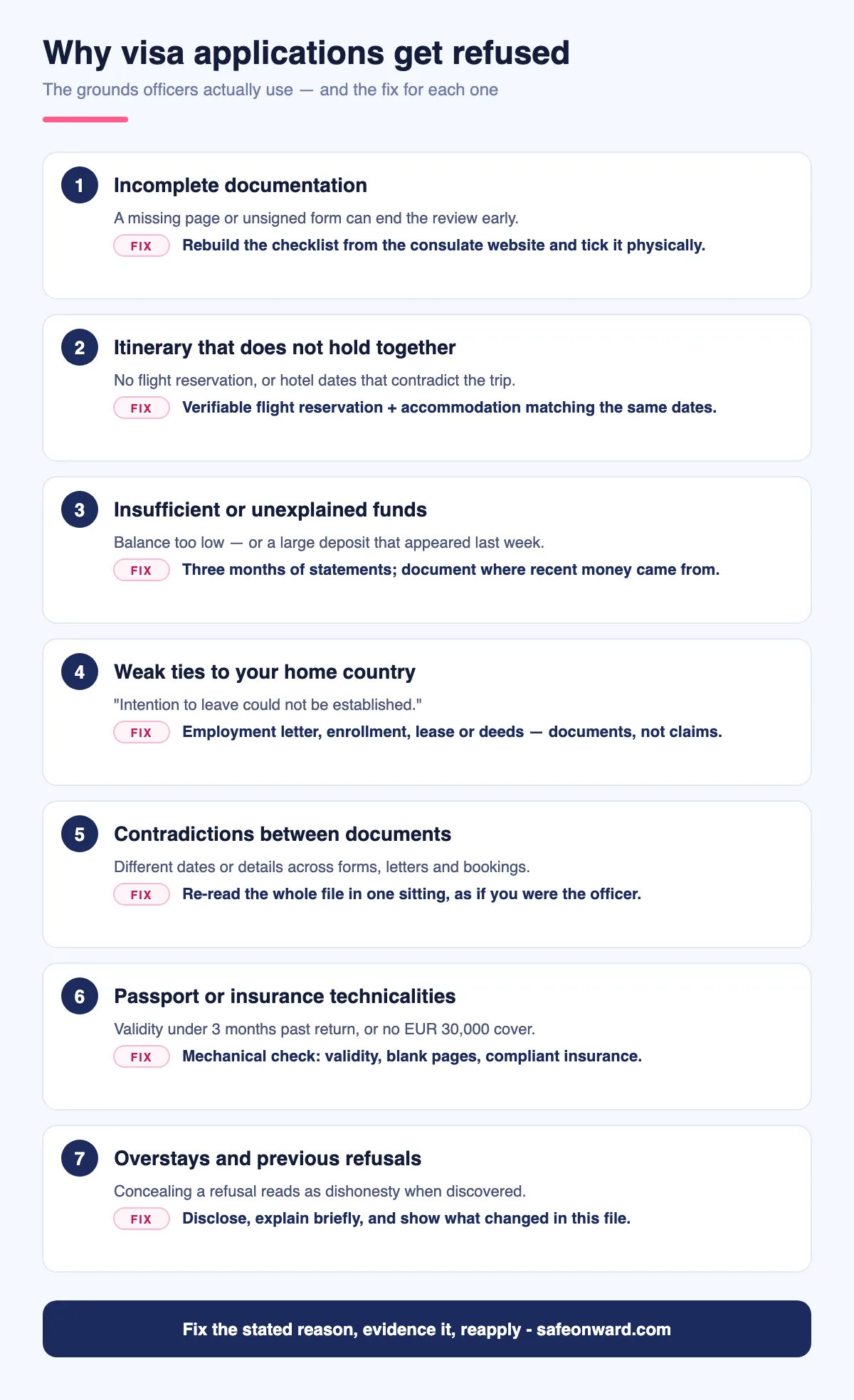
Seven problems to check in your application
1. Incomplete or inconsistent documentation
An unsigned form, an unreadable page or a document missing from the local checklist can leave an important fact unproven. A missing item is not automatically the legal reason for every refusal: read the marked ground.
Review: obtain the latest checklist from the responsible consulate. Compare it line by line with the file you submitted. Check names, dates and addresses across all documents. If a required item was genuinely absent, prepare a complete new file.
2. Travel itinerary that does not hold together
The trip purpose, travel dates, accommodation and transport evidence should describe the same journey. A hotel booking for a different week or an unexplained gap can make the plan hard to verify.
Review: use the consulate's document list to determine whether a flight reservation for a visa is accepted or an issued ticket is required. Match real entry and exit plans to your accommodation and application form. Do not present an expired hold as a confirmed booking. The flight reservation checklist explains the document types.
3. Insufficient or unexplained funds
The file must show sufficient means for the intended stay and return, or lawful access to those means. Required amounts and acceptable evidence vary by destination and individual circumstances. A balance screenshot alone may not explain the source of funds.
Review: follow the consulate's current rules on statement periods and sponsorship documents. Show regular income or explain significant recent deposits with genuine records. Do not assume three months of statements is a universal rule.
4. Weak ties to your home country
The form may state that your intention to leave before the visa expires could not be established. Relevant circumstances can include work, studies, family responsibilities or other commitments, but no single document proves intent by itself.
Review: identify what the original file showed and what it did not. Provide genuine evidence relevant to your own situation, such as approved leave or enrollment, rather than making unsupported claims about ties.
5. Contradictions between documents
Different dates, occupations or addresses across the form, invitation, accommodation and travel documents can make information unreliable. Some differences have a simple explanation; others need corrected documents.
Review: make a date-by-date timeline. Correct errors before filing again and explain legitimate changes briefly with supporting evidence. Never alter a document to make it appear consistent.
6. Passport or insurance technicalities
For a standard short-stay application, the passport normally needs at least two blank pages and validity for at least three months after the intended departure from Schengen. Travel medical insurance generally needs at least €30,000 cover throughout the Schengen area. Check the applicable rules and any exceptions in the European Commission's visa handbook.
Review: check the passport's issue date, expiry and blank pages, then verify the insurance period, territory and cover. Ask the consulate if a special category changes the standard requirements.
7. Your history — overstays and previous refusals
The authorities can assess earlier visas, stays and refusals. But a previous refusal is not an automatic ground for refusing a new application. Every application should be assessed on its own merits.
Review: answer application questions truthfully. If asked about a previous refusal or overstay, give accurate dates and explain any relevant change with evidence. Do not hide facts or assume the earlier outcome decides this one.
Reapply or appeal?
An appeal can challenge an error in the decision; a new application can address missing or changed evidence. Which is appropriate depends on the marked ground, national procedure, filing period, cost and your travel plans. Read the notice first and consult the country-by-country appeal guide.
If you submit again, address the stated reason and keep facts consistent. A new application is assessed individually; it is not guaranteed to succeed merely because you added documents.
Frequently asked questions
Does a refusal ban me from applying again?
No. EU guidance says a previous refusal does not automatically lead to another refusal. You may apply again; first review the reason and current evidence.
Should I buy a real flight ticket to look more serious?
Follow the consulate's checklist. Some official Schengen instructions accept a genuine flight reservation rather than a purchased ticket at application time; other processes may require an issued ticket. Check the difference in proof of onward travel.
The refusal letter only shows a ticked box. How do I know what was really wrong?
The marked box gives the formal ground, not necessarily a detailed explanation of every concern. Compare its wording with the submitted evidence. If necessary, use the contact or review procedure on the notice to seek clarification; do not assume an unmarked reason.
How long should I wait before reapplying?
There is no general EU waiting period after a Schengen refusal. Reapply when you can present an application that addresses the refusal and meets the current consular requirements. Check appointment and processing times before committing to travel dates.
Create a temporary flight reservation for visa files, airline checks, or proof of onward travel.