

In this article 9 sections
A one-way traveler may be asked to show how they will leave the destination. The answer depends on their passport, visa, route and the country’s current rules. Airlines may review travel documents before boarding, and immigration may review them again on arrival. The IATA Travel Centre helps travelers check passport and visa requirements, but the applicable government guidance and your operating airline remain important.
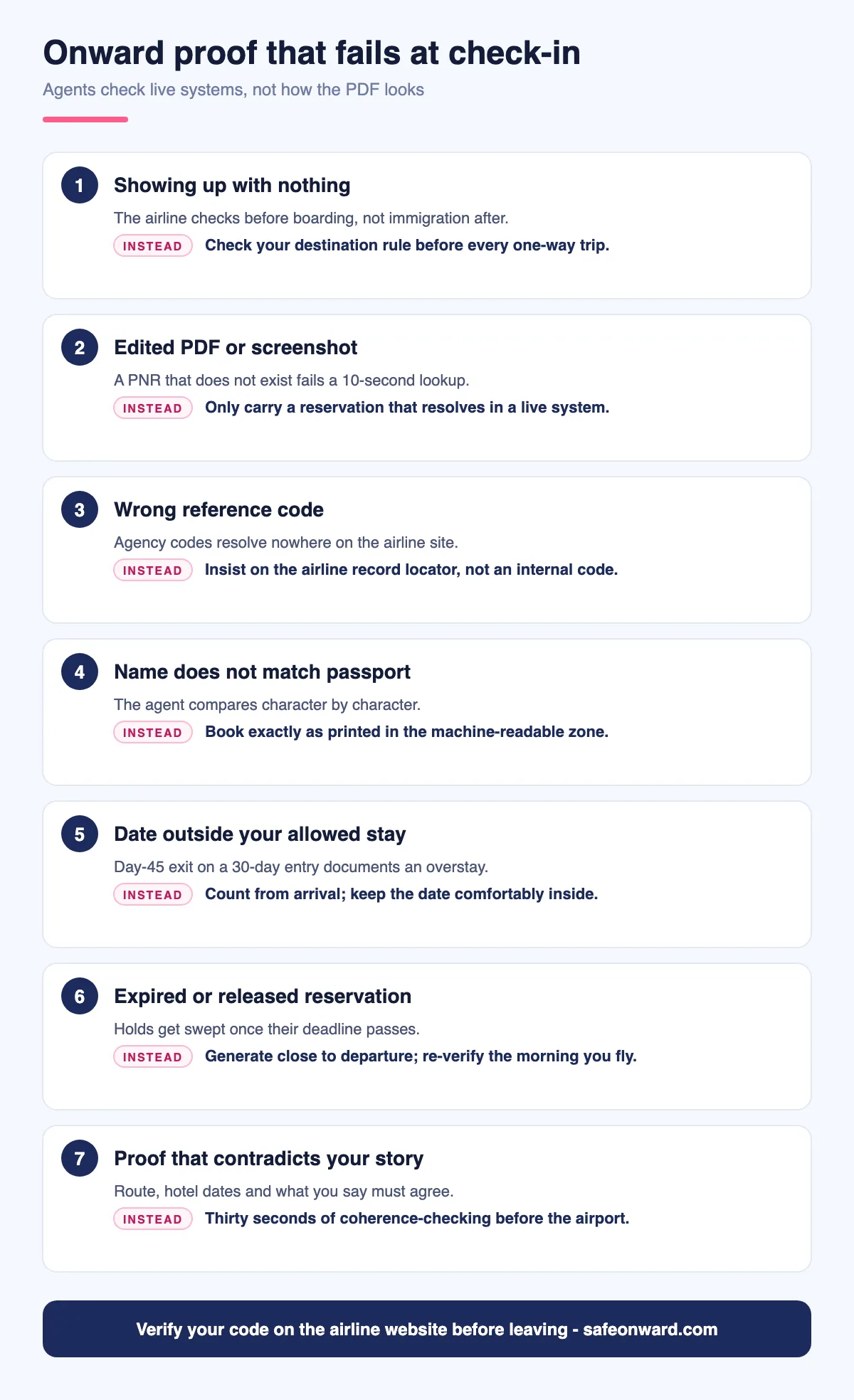
These seven mistakes can make an onward-travel document unusable or raise questions. Check the actual requirement first: some routes call for an issued ticket, while others may accept a reservation or another dated exit document. A booking reference alone does not settle that distinction.
Mistake 1: not checking the rule for your trip
A friend’s experience does not establish the requirement for your passport and visa. A destination may distinguish between tourists, residents and travelers on different visas. A one-way flight can therefore draw questions at check-in even if another traveler was never asked.
Before travel: check the official entry conditions for your category and ask the operating airline what document it expects. Our onward-travel guide explains the document types.
Mistake 2: using an altered or fabricated document
Editing a route, date, name or booking status on a PDF can make it inconsistent with the underlying record. A screenshot alone may also omit the information needed to evaluate the itinerary. Do not claim that a reservation is an issued ticket when it is not.
Before travel: use genuine documents and keep the original confirmation available. If a detail is wrong, ask the issuer to correct the booking rather than changing the image yourself.
Mistake 3: confusing a booking reference with a ticket
A PNR identifies a reservation; it does not by itself prove a ticket was issued or paid for. Airlines and travel agents may also use different references. Some bookings may not be visible in an airline’s public management tool. Emirates explains the difference between its booking reference and ticket number.
Before travel: check the status and document type with the issuer. If the rule calls for a confirmed or issued ticket, obtain that document. If an active reservation is accepted for your particular case, confirm that it is still active.
Mistake 4: a passenger name that does not match
A different surname, omitted traveler or wrong passenger can prevent staff from linking the exit document to your passport. Formatting varies across booking systems, so do not assume every difference is fatal; resolve substantial discrepancies before travel.
Before travel: compare the passenger details with the passport used for the trip. Ask the issuer or airline to correct material errors and carry any relevant name-change document if applicable.
Mistake 5: an exit date outside the permitted stay
An itinerary dated after your current permission expires may fail to show that you plan to leave on time. A possible future extension is not the same as an extension already approved. Visa validity and permitted length of stay may also differ.
Before travel: read the dates and duration on your own entry permission. Choose a departure date within the stay you actually hold, allowing for the country’s counting rules.
Mistake 6: an expired or cancelled booking
A temporary reservation may be released when its ticketing deadline passes. A saved PDF can still look unchanged after the underlying booking is no longer active. An issued ticket can also be changed or cancelled.
Before travel: check the current status through the issuer or carrier before leaving for the airport. If the booking is no longer valid, replace it with a document that meets the rule. Our same-day onward-travel guide covers last-minute checks.
Mistake 7: a route that does not show a real exit
An internal flight does not leave the country. A route beginning in a different country needs a plausible connection, and a journey to a third country also depends on your ability to enter that country. A hotel reservation shows accommodation, not departure.
Before travel: trace every leg from your arrival point to an international exit. Match dates with your stay and other documents. Ask your airline whether it accepts a land or sea ticket for your specific route.
Five checks before the airport
- Confirm the current entry rule for your passport and visa category.
- Identify whether it requires an issued ticket, a reservation or another exit document.
- Compare passenger name, route and departure date with your passport and permitted stay.
- Verify that the booking or ticket is still active and obtain the confirmation the airline requests.
- Save the document offline and keep the issuer’s contact details available.
Frequently asked questions
Does every airline check onward travel?
Checks depend on the route, destination rules and carrier process. Do not rely on a previous trip when planning this one.
Is a bus or train ticket accepted?
That depends on the destination, entry category and operating airline. Confirm the border crossing and ask whether your document satisfies the rule before relying on ground transport.
Can the exit ticket be with another airline?
Often the itinerary can involve another carrier, but confirm that the document meets the destination and operating airline’s requirements. The exit route and ticket status matter more than matching airline brands.
What if the reservation cannot be found?
Ask the issuer which reference and verification channel apply. A public lookup failure does not always prove a booking is invalid, but do not present an expired or unissued booking as a valid ticket. Obtain replacement evidence if the applicable rule requires it.
Create a temporary flight reservation for visa files, airline checks, or proof of onward travel.